Wednesday, November 16, 2011

Minneapolis Street Sighting: Ford Galaxie 500 convertible


I know, I've featured quite a few Galaxies, but most older than this particular car is. I pegged this as a 1969 model (judging by the license plate to be honest), but I'm not quite sure of it being so. I'm honestly not quite "there", when it comes to old Fords. To be honest, I don't know that much about them. I like the styling, don't get me wrong, but tell me a specific model and/or year, and I'd be lying if I said I knew everything about it. Hell, this car, I knew was a Galaxie by the taillights and general front end details. The only reason I know, is because I saw its sedan counterpart earlier in the year. While it seems most post 1978ish Fords are rusty beaters here in Minnesota, older cars aren't quite at that stage yet. This one, at least, looked to be a pretty clean car. Sure, it had some mild paint warp, and the doors weren't exactly flush with the rest of the body, but its big, its old, and it gets driven.
Since this example doesn't have collector plates on it, I can only assume its a daily driver. What a fine daily driver this must be, too. There's gotta be nothing else in the world like cruising through the hoards of Hondas and Toyotas in something so big, so powerful. Because its probably heavy, it likely isn't very fast, even with a stonkin' V8 under the hood. But that isn't why you drive one of these. You drive one to be seen. As I watched the owner drive away, I noticed more than a few people give thumbs up, and/or stare jawslacked. And to be honest, who could blame the onlookers? Isn't the point of being in the classic car hobby to be seen?

Tuesday, November 15, 2011

Minneapolis Street Sighting: Chevy Impala SS


It's not too often that one spots an undonked classic car in my area anymore. With all the "big body whips" being fodder for the donk/high rider craze, even cars such as this '65 Impala SS are slowly disappearing from our streets. To me, a nicely restored (or in this case, still stock) example is that much cooler than a subtle custom. I've seen plenty of custom Impalas, probably enough to last a lifetime. However, I don't see stock ones that often.
This particular Impala was one of a select few that looked great from a distance, but up close it still looked great. The cherry red paint, combined with the dual exhaust and stock hubcaps gave this car a look that says "I'm classy" but also it looks mean, too. I give the owner props for leaving all the stock badging and trim on it. The Impala logos were kept in great shape, as were both bumpers. Heck, I didn't even find any evidence of bendiness on the grille. A rare feat, I imagine.
However, I deduct points for the dumb license plate. Having a plate reading your "nickname" only bodes negatively for the attention this car will likely receive in the near future. It can only mean one thing. Rims, a "sick paint job", and "some bangin' ass sound." Right. Because every classic car needs to be turned into a rolling Soulja Boy concert that can be heard for blocks on end.
If this clean SS were mine, I'd leave it how it is, and put some collector plates on it.

Monday, November 14, 2011

Minnesota Street Sighting: VW Karmann Ghia convertible


As one knows from reading my blog, I have an eccentric taste in cars. I generally like the first iteration of classic car, or at least one bodystyle or generation of a classic car. With VWs, it's often the earlier versions I covet most. As is the case here. When the Karmann Ghia came out in 1957, it truly was a stunning looking car-- definitely not quite what you'd expect from an American manufacturer at the time. It almost looked--dare I say it, Italian. Though, that comes as no surprise given the origin of the name "Karmann Ghia". Karmann was a coach company that made convertible versions of cars from everything ranging from this little VW to the horrible Chrysler Sebring/200 convertible. Carrozzeria Ghia is a coachbuilder that makes tons of concepts/one offs for different carmakers (most those of European origin though.) Sadly enough, this is the same Ghia that has his name plastered on the backs of whatever Ford Granadas are still in existence.
During the Karmann Ghia's evolution, the design became more and more bland, (as did the design of the Beetle). It went from being a svelte, swoopy two door coupe and convertible, to being just another symbol of German mediocrity. This 1972 model marks the last little update before the model's death in 1974. As you can see, the KG has gained ugly chrome bumpers, rather heinous wheels, and an assortment of other pitfalls. What you can't see if the godawful four spoke steering wheels hiding in the interior. If the model was maybe ten years newer, I would've shot better detail shots. As it is, though, the badge on back is my favorite part of this later-run example.
Yes, I did shoot this car before-- really early in my blogging "career". Nice to see it hasn't really changed all that much. Sadly, that can't be said for a vast majority of the street sightings I shoot. While I previously said this car looks great, my knowledge of cars has caught up with me. Yes, it still looks nice from a distance, but up close is where its hard life is evident. The orange hue looks decent, but because of the unequal thickness/glossiness, I can tell this is a pretty old repaint. The wheels, too, look like they've been repainted at some point in their life. That can be both good and bad. Good, because it shows the owner at least cares enough to not let it become a rust hulk, but bad because shoddy resprays generally do lead to rust. In the case, I wonder what this car is hiding.
Would I make this example mine? Probably not. While I don't hate this bodystyle completely, I do fear that this example is a hidden bondotrap. I don't know what kind of life it led, but I only see it every summer driving. In the winter, I've seen it parked under various snowpiles on Iriving Ave, and James Ave. I think if I wanted a decent driver, this is it-- and nothing more.

Sunday, November 13, 2011

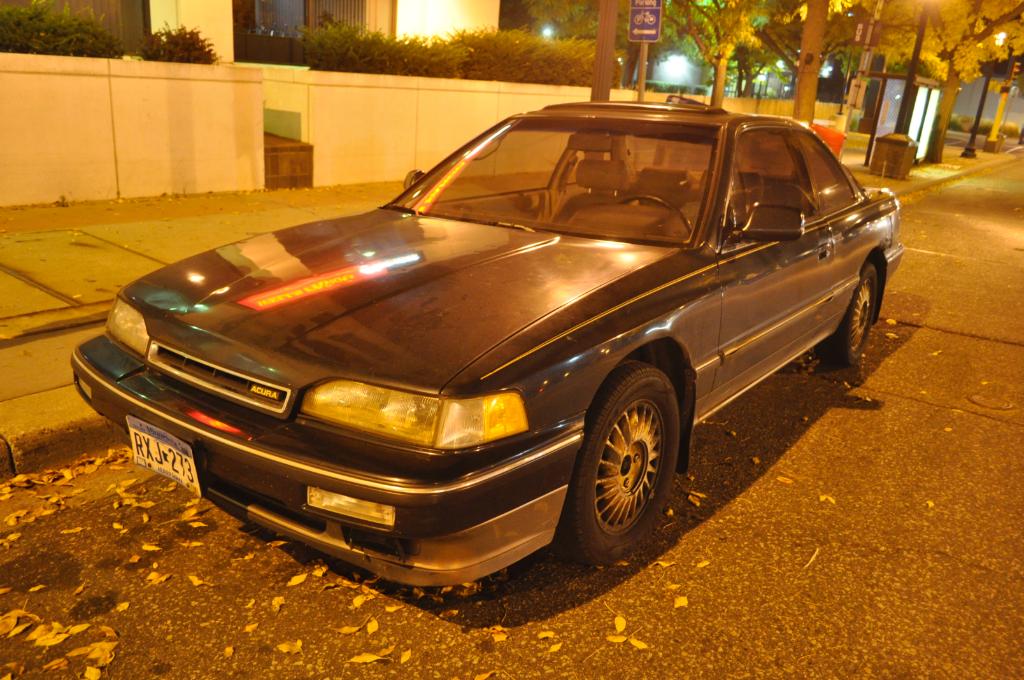
Minneapolis Street Sighting: Acura Legend V6 LS coupe


Normally, when shooting, I try to avoid most modern (ie 1985 to present) cars, but these first-gen Acura Legend coupes hold a soft spot for me. I have liked them ever since I was a wee child, and as I got older, I noticed their rapid disappearance from the street. It's unusual that I come upon on any examples here in the rust belt, so this one made me take notice. Out came my camera, and away I shot.
In 1986, Honda decided it would launch some of its nicer cars here in the US under a different brand to differentiate them for the more mainstream Honda offerings. While Acura cars generally had more luxurious features than those shared on contemporary Honda models, the basic underpinnings were the same. Most people look at an Acura and say "ooh prestige.." but the car guy in me general says "nice, and since it's a Honda, it won't break down." Yep, true. The success of Acura's initial offerings prompted Toyota and Nissan to join in on the Japanese luxury car trend. Their brands were both brought to the US in 1989. While Lexus focused on luxury until recently, Infiniti's main focal point was performance. Honda balanced a middle ground, marketing cars like the Legend shown above, as well as such goodies such as the much debatable NSX sports-car.
From across the street, at nighttime, it looked great. As I crossed the street and examined it more closely, a different story was told. I'm sure at one point, this Legend was a pretty nice car-- and don't get me wrong, it still is. While the paint does have some luster, it seems that tinworm is slowly taking this car by storm. Even the once-nice wheels are starting to get the better of wear, too. Extensive curb rash and grime plague all four corners. Quite sad, because I bet this car could've cleaned up nicely. Shame, too, because there aren't many Legends left, not to mention Legend coupes.

Saturday, November 12, 2011

Minneapolis Street Sighting: Jaguar XJS convertible


I normally pass on most Jaguars, but for some reason this XJS grabbed my attention. Maybe it was the fact that it was red, instead of the normal gray or green that I see these in; perhaps it was the fact that this version of XJS is slightly older than the facelifted versions I usually see. Or maybe, it was because I actually saw it at night-time since I had glasses.
Getting back to the subject at hand, I don't see too many pre facelift XJS' anymore. Maybe the older cars aren't as reliable, maybe the older ones got CFC'd like their XJ6 sibling, or maybe the older ones simply aren't as desirable here in the US as much as they are in the UK. Whatever the case is, this bright red 1980s British icon stood out to me like nothing else on the street.
At first glace, this example looked pretty good, with nary a spec of rust nor even a single ding gracing the bodywork. As I inched closer, I half expected to find out that this gorgeous example 1980s prestige was a rusted, haphazardous used-car "bargain", I was pleasantly surprised. Even up close, the condition held steady. Honestly, this car is belonged to very selective group of vehicles that looked as good up close as the appeared from across the street.
Since this version lacked the requisite V12 badging, I can probably be certain that this particular car has one of two 4.0 sixes, which is quite good. Normally, a V12 is the engine associated with this "legendary" Jag; however, along with copious amounts of grunt, the V12 brings unwanted unreliability. While not fast by any means, the six will do the touring job just fine, while not totally destroying your paycehck when it comes time to fill up the gas tank.
I like the earlier cars like this a lot more than the post-1992 versions. The very early cars (1975-1986) look a tad weird to me (probably the wheels and minor details), and the facelifted ones look cheap. This version (1988? to 1991) is just about right. I would gladly drive one of these, be it a coupe of convertible, and just to spite Jaguar fans, I would keep the six cylinder.